27 October 2025
Institute of Nuclear and Particle Physics, NCSR Demokritos, Athens, Greece
23 October 2025
Torino, Italy
Presentations:
Costas G. Papadopoulos: Towards numerical two-loop integrand reduction
Giuseppe Bevilacqua: On the numerical computation of dimensionally regularised QCD helicity amplitudes
24–30 August 2025
Asia Pacific Center for Theoretical Physics (APCTP), Pohang, South Korea
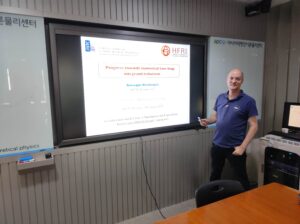
Giuseppe Bevilacqua: Progress towards numerical two-loop integrand reduction
1 – 4 July 2025
National and Kapodistrian University of Athens, Greece
Presentation:
Giuseppe Bevilacqua: Towards numerical two-loop integrand reduction
8-9 April 2025
Presentation:
Giuseppe Bevilacqua: Activities of the HEP-TH group
18–20 December 2024
National and Kapodistrian University of Athens, Greece
Presentation:
Costas Papadopoulos: Amplitude reduction at two loops
30 September 2024 – 4 October 2024
National Centre for Scientific Research (NCSR) “Demokritos”, Athens, Greece
Presentations:
Giuseppe Bevilacqua: Towards numerical computation of dimensionally regularised QCD helicity amplitudes
Costas G. Papadopoulos: Two-loop amplitude reduction with HELAC
Simon Badger: Two loop QCD corrections to multiscale amplitudes: Progress towards ttj, wγγ and hbb final states
Aris-George-Baldur Spourdalakis: Two-loop amplitude reduction in the HELAC framework
Nikos Dokmetzoglou: Analytic Continuation of Five-Point Two-Loop
Master Integrals
10–13 September 2024
University of Turin and INFN, Campus Luigi Einaudi, Turin, Italy
Aris-George-Baldur Spourdalakis: Two-loop amplitude reduction in the HELAC framework
17 – 21 June 2024
Institute for Advanced Study, Princeton, NJ, United States
Presentation:
Nikos Dokmetzoglou: Analytic Continuation of Five-Point Two-Loop Master Integrals
7–10 May 2024
Rome, Italy
Giuseppe Bevilacqua: State of the art predictions for on-/off-shell top-pair production and decays
29 April 2024

Presentation:
Aris Spourdalakis: Two-loop amplitude reduction in the HELAC framework
14–19 April 2024
Wittenberg, Germany
28-29 March 2024
Presentations:
Costas G. Papadopoulos: Activities of the HEP-TH group
Giuseppe Bevilacqua: Towards numerical computation of dimensionally regularised QCD helicity amplitudes
Aris-George-Baldur Spourdalakis: Recent developments in amplitude reduction for HELAC 2-Loop
Nikos Dokmetzoglou: Analytic Continuation of Two-Loop Hexa-Box Integrals
28 August 2023 – 13 October 2023,
Firenze, Italy
Presentations:
Costas G. Papadopoulos: Integrand-level reduction with HELAC2LOOP
Giussepe Bevilacqua: Studying additional jet activity in top pair production at the LHC
29 May – 2 June 2023
Crieff, Scotland
23 – 29 April 2023
Corfu, Greece
Presentation:
Costas G. Papadopoulos: QCD higher-order corrections: current status and prospects
5-8 April 2023
Ioannina, Greece
Presentation:
Costas G. Papadopulos: Higher-order corrections at the LHC: current status and prospects
16 November 2022
Claude Duhr: The mathematics of precision physics
Abstract: Precise predictions for observables in perturbative Quantum Field Theory require the evaluation of multi-loop scattering amplitudes and integrals. We review recent advances in understanding the mathematics underlying perturbative higher-order computations and how they have led to new results for precision collider observables.
23 August 2022
Munich, Germany
Presentation
Costas G. Papadopoulos:
Recent progress in multi-loop & multi-scale integrals
28 June 2022
Dr. Max Zoller: Two-loop tensor integral coefficients in OpenLoops
Abstract: The development of a fully automated tool for the numerical calculation of NNLO corrections to scattering amplitudes is a highly desirable goal for the LHC era. Two-loop amplitudes can be expressed in terms of tensor integrals over two loop momenta with coefficients derived from the Feynman diagrams of a given scattering process. Hence, the calculation can be structured into the computation of the tensor coefficients, the reduction of the tensor integrals and the evaluation of the resulting master integrals. In this talk, we present a new algorithm to numerically construct the tensor coefficients for two-loop amplitudes in the OpenLoops framework. Exploiting the factorisation of Feynman diagrams into universal building blocks, we construct these coefficients in a highly efficient way. The algorithm is completely general and has been fully implemented and tested for QED and QCD corrections to the Standard Model. We will discuss the structure of the algorithm and present studies on its CPU efficiency and numerical stability.
7 September 2021
Simon Badger: Two-to-three scattering amplitudes in QCD
Abstract: I will discuss the on-going efforts to bring theoretical predictions for 2->3 scattering processes in line with experimental measurements. The need to next-to-next-to-leading order (NNLO) QCD predictions for a wide class of experimental signatures has been understood for a long time however computational complexity has always stood in the way of making a complete set of predictions. In this talk I will describe the traditional bottlenecks found in scattering amplitude computations and modern methods that can overcome them.